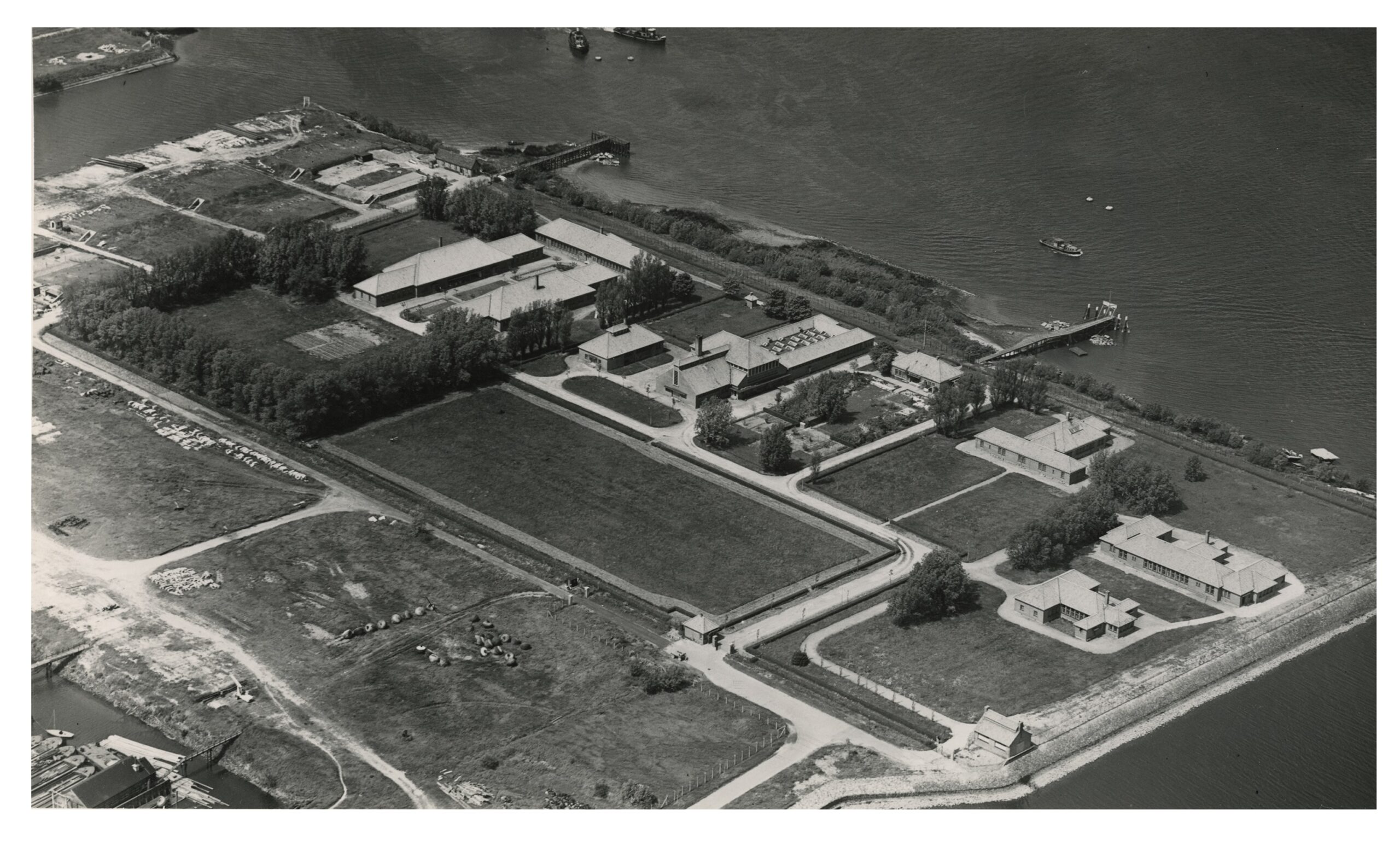
History of the former quarantine station ‘ Quarantaine-Inrichting Beneden Heyplaat’
The construction of QI
In the past every harbor city had to build a quarantine station to receive sailors who were infected with
dangerous tropical diseases.
The ‘Quarantaine- Inrichting Beneden Heyplaat ‘ was developed as a project for unemployed workers from
1928 to 1934, during the years of crisis. The building complex is a design from city architect Van der Steur, in
a straight version of the ‘Amsterdam school’ style.
In 1934 the complex was finished. Twelve buildings with each their own function were situated on an area of
6 hectares, a porters lodge, a mortuary, a hospital barrack, an isolation barrack, a nurses home, a caretaker’s
house, a bathhouse and decontamination building, a kitchen barrack and three contact barracks. The area
was enclosed by a high fence with a main entrance On the riverside a wooden pier has been built for ships in
quarantine.
In quarantine
During the construction period, the function of the complex appeared to have been overtaken by history. The
penicillin was developed, and at the same time the Haven Hospital was built, with a special isolation ward for
tropical diseases. Rotterdam grew very quickly and the QI site therefore came to be close to built-up areas.
Infected ships were therefore kept out of port at Hoek van Holland. Patients were taken by helicopter directly
to the Haven Hospital .
After this period the Quarantine Station was in use for various purposes.
Ward for tuberculosis patients,1947-1953.
Mandatory quarantine for emigrants, especially Jewish refugees from Eastern Europe, traveling by ship to America, 1930s.
Confiscated by the German Kriegsmarine during World War II, 1940-1945,
Treatment of patients during a typhus epidemic in Spijkenisse in 1945,
Disinfecting/delousing part of the Rotterdam population shortly after liberation, 1945,
Treatment of one smallpox patient from the Dutch East Indies, 1949,
Department for tuberculosis patients, 1947-1953.
Vacancy
From 1953 the contact barracks were used as an annex to the psychiatric hospital Delta for the elderly
patients, due to lack of space in the hospital. The rest of the complex was vacant and was kept operational by
the City Health Service ( G.G.& G.D ). The caretaker’s house remained in use.
Cultural destination 1979.
Foundation Image & Sound (stichting Beeld & Geluid), founded by students of the Academy of Arts and the
Rotterdam conservatorium , requested to the Board of Mayor and Eldermen of Rotterdam permission to use
the Quarantine Station for cultural purposes
The contact barracks and the caretaker’s house were still in use.
The rest of the complex had been vacant since 1953.
Proposal from the Sound & Vision Foundation for use of the buildings:
Painting and sculpture studios, a music studio, a dance studio, a screen printing room and living quarters for
the users. They were given permission for temporary use without a lease. Since then, the QI-site has had an
unofficial cultural destination.
Demolition
At various times the site has been threatened with demolition. After 1981, when the new Delta hospital was
completed, the G.G & G.D. transferred the entire site to the Municipal Port Autority ( Gemeentelijk Haven
bedrijf), which wanted to develop the 6 hectare into a harbor area.
In 1984, the inhabitants were summoned to leave, without there being any reallocation for the buildings.
Several artists moved to the centre of Rotterdam.
Between 1986 and 1991 the contact barracks have been demolished and 3 hectares of the site were
prepared for construction. The demolition of the other buildings was narrowly prevented by objection of the
entrepeneurs/residents to the cie. objection and appeal R’dam. The remaining part of the Quarantine Facility
had just been placed on the provisional list of Municipal Monuments on the initiative of the residents, as the
last remaining Quarantine Station in the Netherlands. The demolition and lifting permits were declared
invalid, based on this provisional monument status. After that demolition was no longer possible.
Cultural production site
In 43 years, the QI site has grown into a professional production site for the cultural sector and is now
Rotterdam’s longest-standing artists’ initiative
Visual arts, design, music, film and theater productions are developed here and find their way to the public in
galleries, theaters and on film and TV. The site also functions as a host for all kinds of art projects.
Monument
In April 2010 the remaining area of the QI site has officially become a national monument, due to repeated
promotion by the residents of the former Quarantine Station and Heijplaat.
Plan Port Authority
The Port of Rotterdam Authority wanted to rent out the QI site in the future to companies that would expand
from the RDM campus to another location. The residents of QI and the tenants’ association of Heijplaat
objected to this plan, and successfully. The new zoning plan of 2018 stipulates that the cultural destination
will be maintained and that the site will become a protected cityscape.
In addition, the zoning plan specifies that the buildings will be rented out as workshops, studios, small offices
and for (nature) education. The green part of the QI site will be redesigned, while retaining its natural
function.
BOEi Plan, 2024:
QI’s future is once again threatened. The Port Authority has transferred the national monument to BOEi, with the mandate to develop the buildings into a hotel and conference center. This would eliminate the possibility of maintaining and expanding the studios and workshops at QI, while Rotterdam has a dire shortage of workspace. For a hotel, more parking spaces and street lighting would be installed, which would severely disrupt the natural function and erode the site’s special character.
The QI artists attempted to prevent this through consultations with BOEi, the municipality, and cultural institutions. For the fifth time, they are taking action to protect the former Quarantine Facility. In 2024, the studios were vacated on BOEi’s behalf. Since then, the buildings have stood empty, awaiting new development. The future is uncertain. Hopefully, the QI site will be treated with respect and the area will remain as surprising, unregulated, and beautiful as it is now.
A brief history of QI
by Louike Duran